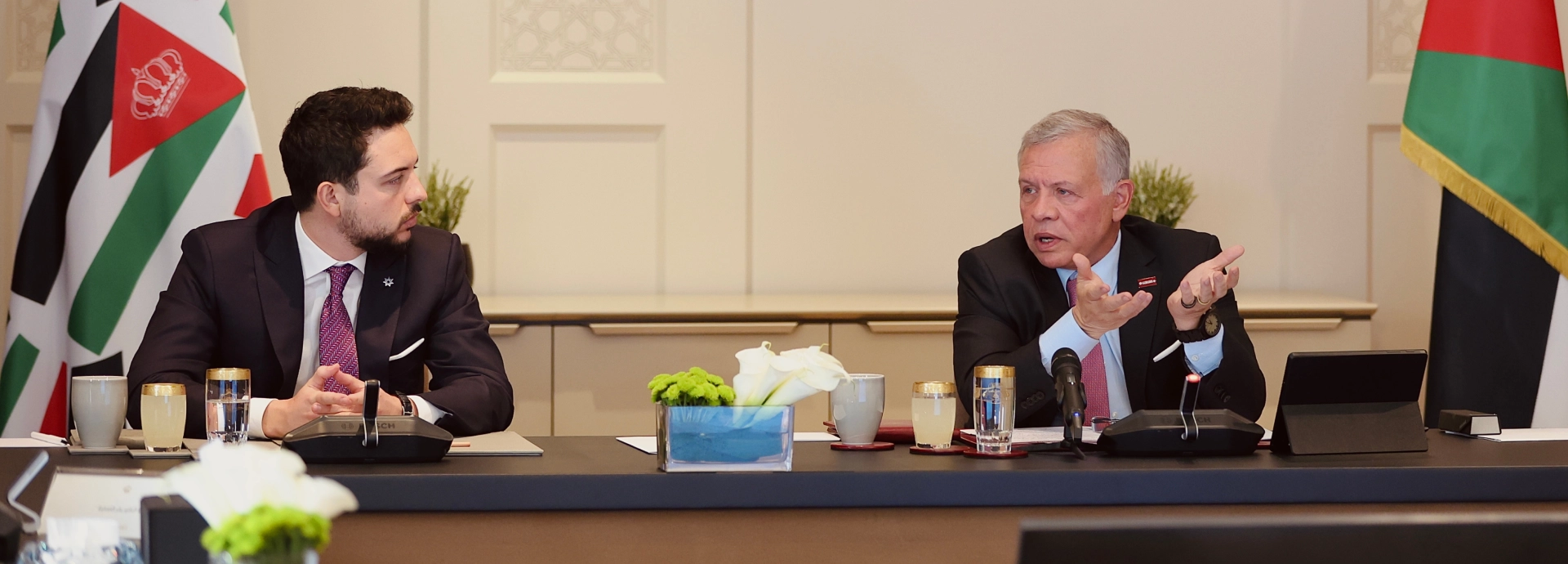
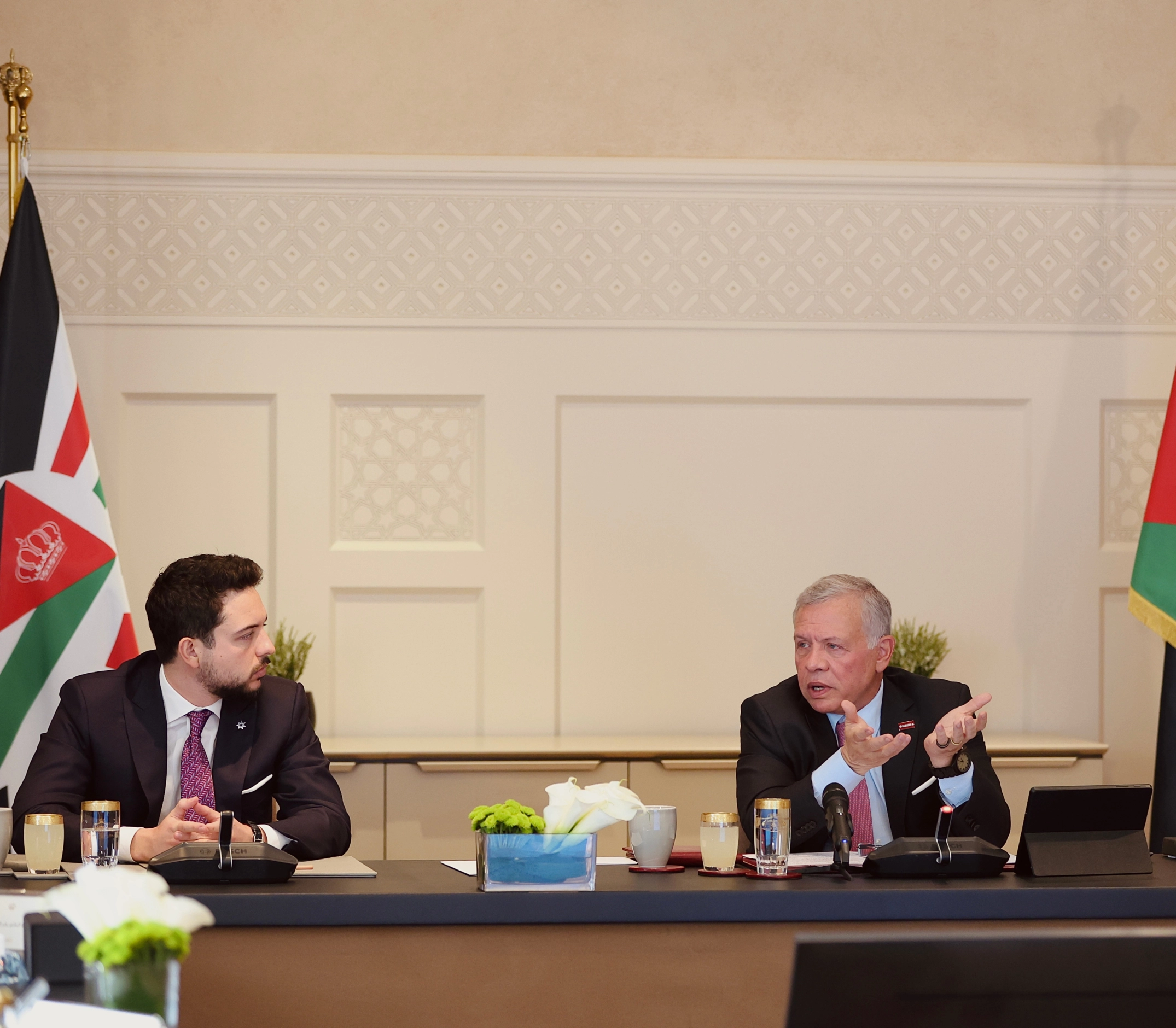
His Majesty King Abdullah II’s address at the General Debate session of the 81st United Nations General Assembly – September 2026
22 September 2026
In the Name of God, the Compassionate, the Merciful
Mr. President,
Mr. Secretary General,
Your Excellencies,
Every generation believes the challenges they face are unmatched.
Perhaps for us that is true.
We are at a unique moment in history; the scale of knowledge and the speed of change are unprecedented. Every day brings another crisis, another tragedy, another emergency, demanding our attention.
One study shows that average screen attention has fallen from 2.5 minutes in 2004 to just 47 seconds today.
Of course, a screen is not the world, but that says something about our world today: that attention has become a scarce asset, and where we choose to direct it has never mattered more.
And in this chamber, attention is more than a cognitive resource. It is a geopolitical one.
It determines which conflicts receive sustained diplomacy and which fade from the agenda.
Whether a ceasefire holds after the cameras leave.
Whether humanitarian suffering remains intolerable, or becomes familiar.
And whether the world steps up, or scrolls and strolls away.
History rarely catches us entirely by surprise. More often, it catches us focused elsewhere.
Economic disparity, food insecurity, climate change disasters. None of these challenges emerged overnight.
The warning signs have been there. The question is whether our attention lasts long enough to act.
And what we neglect has a habit of shaping our future.
Your Excellencies,
We see the cost of that neglect every day.
In my region, from Lebanon to Yemen, to Sudan, protracted conflict is deepening humanitarian suffering.
And if anyone had any doubt that a crisis in our part of the world stays there, just look at the energy and grocery bills of ordinary families, from Mumbai to Madrid to Minnesota.
The Iran war has shown how quickly instability can disrupt trade, investment, and lives beyond the region.
Then there is Gaza.
For decades, I have stood before this Assembly and warned of the dangers of leaving the Palestinian-Israeli conflict unresolved.
But the international community chose to manage the conflict, not confront it.
And every new Israeli violation was treated as “temporary”, diverting attention from the reality being created on the ground. Until temporary became permanent, and permanent became policy.
Of course, this is not the world’s only injustice. But one of the world’s longest-running occupations forces a basic question: If international law can be ignored for decades, then what exactly is that law worth?
And how can we enforce it if we won’t even call out its violations?
In Gaza, the evidence is overwhelming: In the first 300 days of the so-called ceasefire, at least 300 Palestinian children were killed. Jordan’s field hospitals have also been targeted. President Trump has pushed hard for peace and a path to end this war. But this Israeli government keeps moving the goalposts, continuing its attacks and destruction of civilian infrastructure, refusing to withdraw, and squeezing Palestinians into barely a third of Gaza.
This can no longer be dismissed as temporary military measures, or a consequence of war. Accountability begins when we call things what they are: an attempt to erase Palestinian life and impose a new territorial reality in Gaza.
And while the world has been focused on Gaza, something extraordinarily dangerous is unfolding in the West Bank.
Some may think we have seen this before.
Settlements. Violence. Displacement. More of the same.
But it is not. Nor is it simply an escalation. This is a fundamental shift.
What was once a creeping process has exploded into something far more aggressive.
Settler violence is rampant. Palestinians are being beaten, shot and terrorised. Homes torched. Property destroyed. Families driven from their land.
And Israel is tightening its grip on more of the West Bank, seizing land, expanding settlements and pushing Palestinians out.
It is time to see what is happening for what it really is. Because when the language is sanitised, the actions become normalised.
Demolishing Palestinian homes to expand illegal settlements is not “law enforcement.” It is forcible transfer.
Appropriating occupied land is not “land registration.” It is de-facto annexation.
A choking network of checkpoints and barriers is not “security” infrastructure. It is a system of subjugation.
Systematic attacks on Palestinian communities are not “settler unrest.”
The Israeli government ‘criticises’ the violence before international audiences. They call those responsible a “handful of rioters.” They assure us that Israel is a country governed by law.
Yet, what’s happening on the ground says otherwise: Israeli soldiers stand by as settlers attack Palestinians, often protecting the attackers or joining them. They have blocked ambulances from reaching the injured. They have targeted international journalists who are trying to say the truth.
And when soldiers watch, enable, and sometime even participate in violence against civilians, this is no longer about “a handful of rioters.”
And the question is no longer whether a few extremists are breaking the law. The question is, is this the behaviour of a democratic state governed by law?
What is unfolding across the West Bank is not a series of isolated acts. It is elements of a single policy to compel an entire population to leave their land.
And there is a name for that: forced displacement.
And that is a war crime.
Your Excellencies,
If we are to resolve the Palestinian-Israeli conflict, the world must abandon some illusions:
The first is that Gaza and the West Bank are separate stories. They are not. They are two fronts of the same Israeli strategy. In both, Palestinians are being killed. In both, the reality on the ground is being remade. Gaza through destruction. The West Bank through de-facto annexation.
The objective is the same: To make a viable Palestinian state impossible.
Another illusion is that this Israeli leadership’s rejection of Palestinian statehood is a position that might yet change. It is not. It is being cemented on the ground.
This government has been accelerating settlements and land seizures.
But it began long before. Since Oslo, the map has changed—piece by piece, settlement by settlement.
And the most dangerous illusion:
That the Arab world never sought peace.
The Arab Peace Initiative in 2002 offered Israel normalisation with 57 Arab and Muslim states, including Iran and Iraq at the time, in exchange for peace and Palestinian statehood.
For over twenty years, that offer has stood. The obstacle hasn’t been the absence of a partner for peace, but the absence of an Israeli government willing to accept it.
This Israeli government understands the power of attention. And lately, it has not liked the attention it’s been getting.
When confronted with evidence of wrongdoing, rather than change course, it opts for distraction, discrediting its critics.
It has also tried to cast this conflict as a war of religions; Islam on one side, Judaism and Christianity on the other. It is not. This is about whether Palestinians—Muslims and Christians—are entitled to the same rights as everyone else.
Distractions will not fly anymore; people across the world are paying attention.
The question now is: will we act?
Because the world’s political inaction is not for lack of options. So, let’s call it what it is: a choice.
We have tools:
Sanctions, asset freezes, embargoes, diplomatic isolation. And we have a record of using them elsewhere.
Yet with Israel, resolutions end where they begin: on paper.
The result is a state without restraint.
This government’s sense of impunity has reached terrifying levels: It no longer feels compelled to ask, “Can we get away with this?” It already knows the answer.
And that is precisely why no one in this Assembly should assume its ambitions stop at Palestine.
This Israeli government’s expansionist appetite is now a regional threat. And today, Syria is the warning the international community is choosing not to see.
Repeated incursions. Creeping territorial expansion. New facts imposed on the ground, including around vital water resources.
Step by calculated step, Israel is testing how far it can go. And every time the international community looks away, Israel learns that it can go even further across border lines and legal limits.
For Jordan, there is no ambiguity. Any threat to our northern border, or our water security, is a threat to our national security. Jordan will not look away; we will protect our security, our water, and the interests of our people.
And the question here is: If Israel continues its antagonistic approach in Southern Syria, will the international community stand by, and let that happen?
Your Excellencies,
Some things demand our immediate attention. Others demand sustained attention. Injustice demands both.
Jordan understands this all too well.
We know what it means to live in a region where one crisis arrives before the last has receded.
And we know that we cannot choose between responding to the emergency before us and building the future beyond it.
So, we are doing both.
We are strengthening connections from the Gulf to the Mediterranean as a hub for trade, industry, and technology—while responding to humanitarian crises.
We are confronting terrorism in the region and beyond—while developing our own defences and remaining a frontline against threats like narcotics.
We are protecting Christianity—its communities and heritage—in its native and historic land, while promoting the true image of Islam against the voices of hate.
And through it all, we will not abandon our commitment to a just peace.
We will continue to support Palestinian resilience.
We will continue supporting UNRWA.
And we will continue to uphold the Hashemite Custodianship and historic and legal status quo at Muslim and Christian holy sites in Jerusalem.
Most importantly, Jordan is striving to build a different model:
Principled, open and steady.
At a time when certainty is rare and politics can shift by the day.
A country the world can count on: true to our principles, true to our word, ready to talk to everyone, and ready to work with anyone seeking peace.
However, our bias towards diplomacy will never supersede our commitment to human values, and should not be taken for granted or mistaken for weakness.
My friends,
Whether in Gaza, Sudan, Ukraine, or anywhere people live with war, displacement, and fear.
Whether a crisis began weeks ago, or has endured for decades.
Our principles cannot change with the world's attention.
Military force cannot deliver meaningful solutions. It cannot feed the hungry, return the displaced, or build peace. Nor can it repair our planet, manage mass migration, or guide technological progress.
That requires institutions that command legitimacy. And it requires trust. Trust between nations. Trust in agreements. Trust that rules will actually be enforced.
Destroy that trust, and every challenge becomes harder.
Preserve it, and cooperation becomes possible.
And in a world competing for our attention, we must be deliberate about where we direct it, and vigilant about what seeks to distract it.
The future is shaped not only by what we do, but by what we choose to ignore.